
Reading Is More Than Decoding
Understanding the Role of Language Comprehension in Reading
Many conversations about reading focus on decoding, phonics, and fluency. These are important skills as children need to understand how print works, read words accurately, and build automatic word recognition.
However, decoding is only one part of reading.
A child can read words accurately and still have difficulty understanding what the text means. A child can sound fluent and still struggle to explain, infer, summarize, or learn from what they read. When this happens, the difficulty may not be word reading. It may be language comprehension
This is especially important for children with language disorders. When language is difficult, reading comprehension, writing, and classroom learning can be difficult too.
The Simple View of Reading
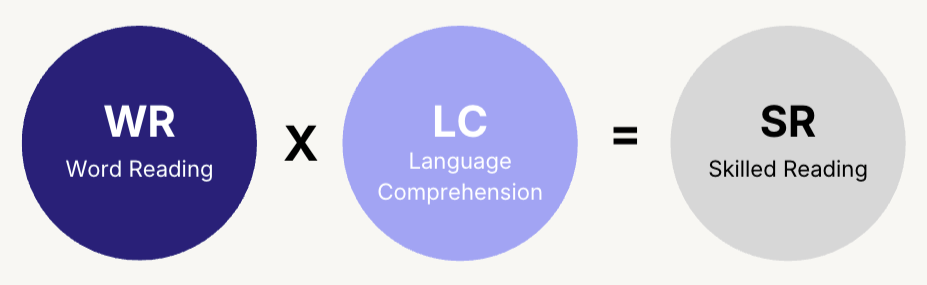
The Simple View of Reading explains reading comprehension as the product of two broad components: word recognition and language comprehension (Gough & Tunmer, 1986).
Word recognition includes the skills needed to read printed words accurately and efficiently, including decoding, sight word recognition, and reading fluency.
Language comprehension includes the skills needed to understand meaning. These include vocabulary, sentence comprehension, morphology, inference, background knowledge, narrative understanding, and verbal reasoning.
Both components are necessary. Weak word recognition can interfere with access to the text. Weak language comprehension can interfere with meaning, even when word reading appears adequate.
This is why reading comprehension problems do not always look the same. Some students struggle primarily with decoding. Some struggle primarily with language comprehension. Some struggle with both.
Scarborough’s Reading Rope
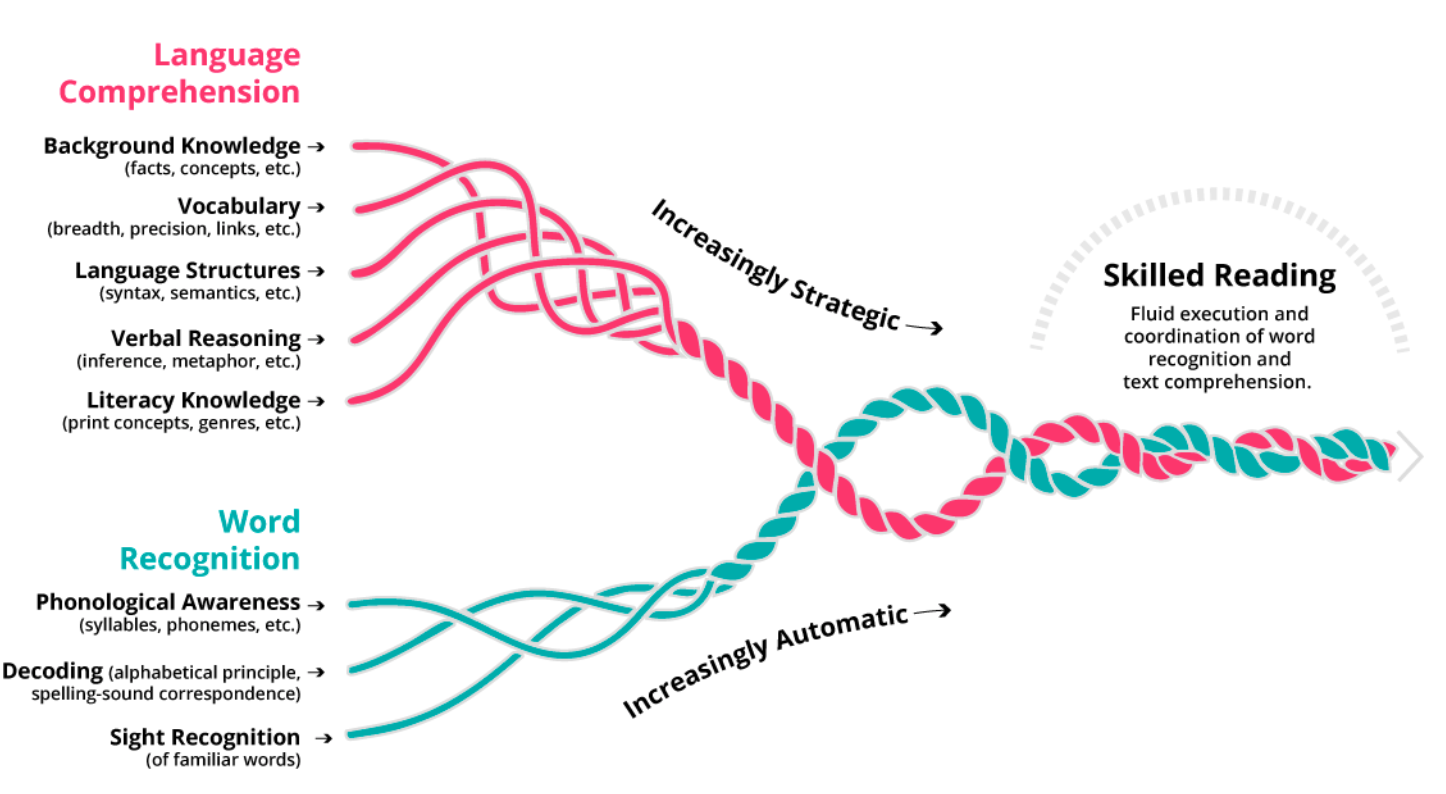
Scarborough, H. S. (2001).
Scarborough’s Reading Rope provides a related way to understand skilled reading. The model illustrates reading as the coordination of multiple strands, including word recognition strands and language comprehension strands (Scarborough, 2001).
The word recognition strands include phonological awareness, decoding, and sight recognition of familiar words. The language comprehension strands include background knowledge, vocabulary, language structures, verbal reasoning, and literacy knowledge.
As children become skilled readers, these strands become increasingly integrated and automatic. This model is helpful because it shows that reading is not a single skill. It is a developing system that depends on both accurate word reading and increasingly sophisticated language comprehension.
Why This Matters for Children With DLD
DLD is a language disorder that affects how children understand and use language. Children with DLD may have difficulty with vocabulary, grammar, sentence comprehension, narrative language, inference, oral explanation, and the use of language for learning.
These are also skills that support reading comprehension.
For some children with DLD, word reading may not be the primary concern. They may decode accurately, read fluently, or perform adequately on measures of basic reading skills. Yet they may still struggle to understand what they read, answer questions about text, summarize important information, make inferences, or use reading to learn new academic content.
These difficulties are still reading difficulties. They reflect weaknesses in the language comprehension side of reading.
This is one reason DLD can be missed in school-age children. If reading concerns are viewed mainly through the lens of decoding, children with language-based comprehension difficulties may not be identified until academic demands increase.
Looking Beyond Word Reading
A complete understanding of reading requires attention to both word recognition and language comprehension.
When a student struggles with reading comprehension, assessment should not stop with phonological awareness, decoding, fluency, and spelling. It should also examine the language skills that support comprehension, including vocabulary, syntax, morphology, narrative language, inference, listening comprehension, and oral expression.
Without this broader view, teams may identify that a student is struggling without understanding why. A child may be described as having poor comprehension, weak attention, low motivation, or difficulty with higher-level thinking, when the underlying issue is language.
For children with DLD, reading and writing difficulties may not represent a separate problem. They may be the same language disorder becoming visible through literacy and academic learning.
Reading is more than decoding.
Accurate word reading supports comprehension, but it does not guarantee it. Students also need the language skills required to understand vocabulary, sentences, ideas, and connections across text.
When we recognize the role of language comprehension in reading, we are better able to identify and support students whose learning difficulties are language-based.
-
Gough, P. B., & Tunmer, W. E. (1986). Decoding, reading, and reading disability. Remedial and Special Education, 7(1), 6–10.
Scarborough, H. S. (2001). Connecting early language and literacy to later reading disabilities: Evidence, theory, and practice. In S. B. Neuman & D. K. Dickinson (Eds.), Handbook of early literacy research (pp. 97–110). Guilford Press.
