
Beyond Dyslexia: Why Language Comprehension Matters for Reading
Conversations about reading often begin with dyslexia, and for good reason.
Recognition of dyslexia has improved awareness of the important relationship between language and reading. Increased attention to phonological processing, decoding, and reading intervention has helped many children receive appropriate identification and support.
But dyslexia is only one type of language-based learning disability.
Many children struggle with reading for a different reason. They can decode words accurately, read aloud fluently, and perform well on word reading measures, yet still have difficulty understanding what they read. These students often have developmental language disorder (DLD), a neurodevelopmental disorder that affects the language skills needed for learning, communication, and literacy (Bishop et al., 2017; Norbury et al., 2016).
Reading Requires More Than Word Reading
The Simple View of Reading explains that reading comprehension depends on two broad skill areas (Gough & Tunmer, 1986):
Reading Comprehension = Word Recognition × Language Comprehension
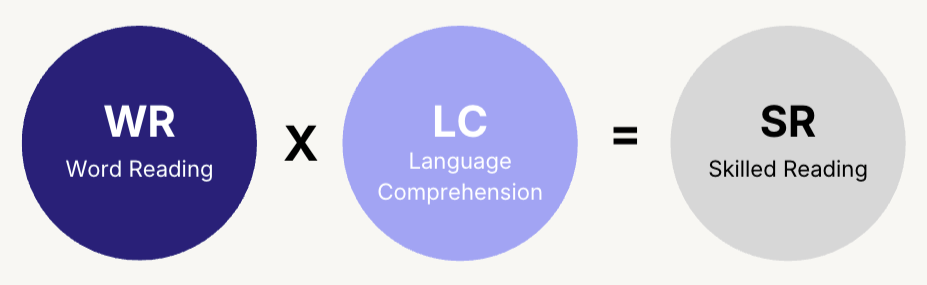
Word recognition includes:
Decoding
Sight word recognition
Reading fluency
Language comprehension includes:
Vocabulary
Sentence comprehension
Morphology
Inferencing
Background knowledge
Narrative understanding
Verbal reasoning
Both components are necessary for successful reading comprehension.
A child may decode every word on the page correctly and still struggle to understand the text if language comprehension is weak.
Four Reading Profiles
One helpful way to understand reading difficulties is to consider students across two dimensions: word recognition and language comprehension.
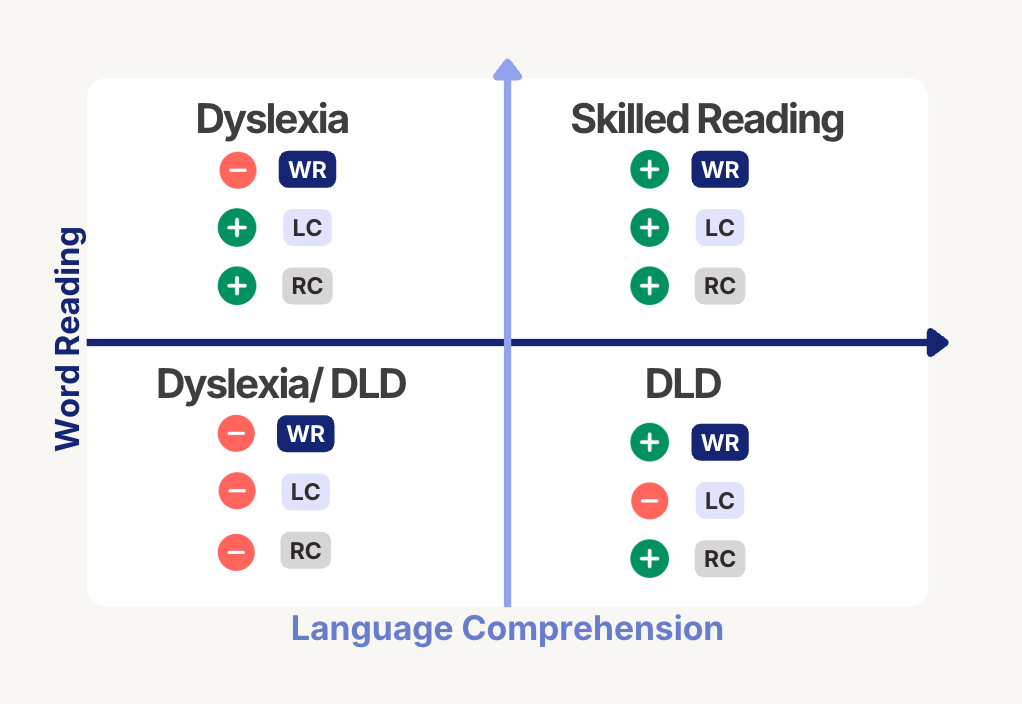
The quadrant illustrates four common reading profiles.
Students with strong word recognition and strong language comprehension typically develop skilled reading.
Students with weak word recognition but relatively strong language comprehension often fit the profile associated with dyslexia. Their primary difficulty lies in decoding printed words accurately and efficiently.
Students with strong word recognition but weak language comprehension often fit the profile seen in developmental language disorder. These students may read aloud fluently and accurately, yet struggle to understand vocabulary, interpret complex sentences, make inferences, summarize information, and construct meaning from text.
Students with weaknesses in both word recognition and language comprehension experience challenges across both domains and often have the greatest difficulty with reading comprehension.
Thinking about reading in this way reminds us that reading difficulties are not all caused by the same underlying weakness.
Different Reading Profiles
Children with dyslexia and children with DLD often present with different learning profiles.
Children with dyslexia typically experience difficulty with accurate and fluent word reading because of weaknesses in phonological processing (Peterson & Pennington, 2015).
Children with DLD often show the opposite pattern. Word reading may be average or even strong, while language comprehension is significantly affected. They may have difficulty understanding vocabulary, following complex sentences, making inferences, organizing ideas, and constructing meaning from what they read (Catts et al., 2006; Bishop & Snowling, 2004).
In the classroom, these students may appear to be capable readers because they read smoothly aloud. Their difficulties often become apparent only when they are asked to explain what they read, answer higher-level questions, summarize information, or write about the text.
Many Children Have Both
These profiles are not mutually exclusive.
Research suggests that approximately 50% of children with DLD also meet criteria for dyslexia, with the most significant reading comprehension difficulties occurring in children who have both conditions (Catts et al., 2005).
This overlap reinforces an important point: reading depends on multiple language systems working together.
Why This Matters
Many school screening systems emphasize decoding and reading fluency.
These measures are valuable, but they primarily identify students whose reading difficulties stem from weaknesses in word recognition.
Students whose primary difficulty is language comprehension may perform adequately on these screeners while continuing to struggle academically. As language demands increase across grade levels, these students often experience increasing difficulty with reading comprehension, written expression, learning from text, and classroom participation (Catts et al., 2002; Snowling et al., 2000).
Without comprehensive language assessment, their underlying language disorder may remain unidentified.
Looking Beyond Dyslexia
Improving literacy outcomes requires looking beyond decoding alone.
Comprehensive evaluation should examine both word recognition and language comprehension. Understanding how a student processes spoken and written language provides a more complete picture of why reading difficulties occur and helps guide appropriate intervention and educational planning.
-
Bishop, D. V. M., & Snowling, M. J. (2004). Developmental dyslexia and specific language impairment: Same or different? Psychological Bulletin, 130(6), 858–886.
Bishop, D. V. M., Snowling, M. J., Thompson, P. A., & Greenhalgh, T. (2017). Phase 2 of CATALISE: A multinational and multidisciplinary Delphi consensus study of problems with language development. Journal of Child Psychology and Psychiatry, 58(10), 1068–1080.
Catts, H. W., Adlof, S. M., Hogan, T. P., & Weismer, S. E. (2005). Are specific language impairment and dyslexia distinct disorders? Journal of Speech, Language, and Hearing Research, 48(6), 1378–1396.
Catts, H. W., Fey, M. E., Tomblin, J. B., & Zhang, X. (2002). A longitudinal investigation of reading outcomes in children with language impairments.
Catts, H. W., Hogan, T. P., & Adlof, S. M. (2006). Developmental changes in reading and reading disabilities.
Gough, P. B., & Tunmer, W. E. (1986). Decoding, reading, and reading disability. Remedial and Special Education, 7(1), 6–10.
Norbury, C. F., Gooch, D., Wray, C., et al. (2016). The impact of nonverbal ability on prevalence and clinical presentation of developmental language disorder.
Peterson, R. L., & Pennington, B. F. (2015). Developmental dyslexia. Annual Review of Clinical Psychology, 11, 283–307.
Snowling, M. J., Bishop, D. V. M., & Stothard, S. E. (2000). Is preschool language impairment a risk factor for dyslexia in adolescence?
